

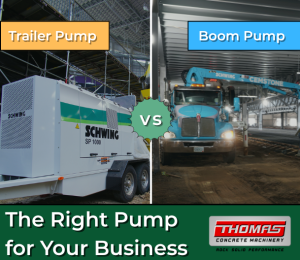
Choosing between a trailer pump vs boom pump is a common decision contractors face when investing in concrete pumping equipment. The right concrete pump can improve productivity, reduce labor costs, and keep projects running on schedule. While both are essential tools in the concrete industry; they serve very different purposes.
Understanding the strengths of each can help you make a smarter investment for your business.
What is a Trailer Pump?
Trailer pumps—also known as line pumps—are compact, towable units that move concrete through a system of hoses or steel pipes. They are widely used across residential, commercial, and infrastructure projects.
Why Contractors Choose Trailer Pumps
- Lower upfront cost compared to boom pumps
- Flexible setup for tight or hard-to-reach jobsites
- Ideal for sidewalks, slabs, foundations and flatwork
- Easier Transport and storage
Trailer pumps are a strong choice for contractors who value versatility and affordability while still needing consistent pumping performance.
What is a Boom Pump?
Boom pumps feature a hydraulic, articulating arm (the “boom”) that places concrete quickly and precisely—often at significant heights or distances.
Why Contractors Choose Boom Pumps
- Faster placement on large pours
- Ability to reach elevated or difficult placements
- Reduced labor required for hose handling
- Increased productivity on multi-story or high-volume jobs
Boom pumps are commonly used on commercial buildings, bridges, high-rises, and large infrastructure projects where speed and reach are critical.
Trailer Pump vs Boom Pump: Cost and Jobsite Efficiency
| Feature | Trailer Pump | Boom Pump |
|---|---|---|
| Initial Investment | Lower | Higher |
| Reach & Placement | Hose or pipe | Hydraulic boom |
| Crew Size | Larger | Smaller |
| Setup Speed | Moderate | Faster |
| Best Applications | Residential & light commercial | Large commercial & infrastructure |
Which Is Better for Your Business?
The right choice depends on the type of work you do most often.
A Trailer Pump May Be the Better Fit If You:
- Handle residential or light commercial projects
- Work in tight spaces or neighborhoods
- want a cost-effective, versatile solution
- Frequently move between smaller jobsites
A Boom Pump May Be the Better Fit If You:
- Perform large commercial or vertical construction work
- Prioritize speed and efficiency
- want to reduce labor demands on the jobsite
- Regularly place concrete at height or long distances
Some contractors even choose to operate both, using trailer pumps for everyday jobs and boom pumps for larger, specialized pours.
Long-Term Considerations
Beyond the initial purchase price, it’s important to factor in:
- Maintenance and service support
- Parts availability
- Operator training
- Equipment uptime
Working with an authorized dealer ensures access to OEM parts, certified service and expert guidance, helping protect your investment over the long haul.
Let Thomas Concrete Machinery Help You Decide
At Thomas Concrete Machinery, we work closely with contractors across the Southeast to match them with the right equipment for their needs. Whether you’re considering a trailer pump, a boom pump, or expanding your fleet, our team is here to help you evaluate your options with confidence.
Contact our sales team today to discuss which pump makes the most sense for you and your business.